Archives

HUMMINGBIRDS GIVE WAY TO CAROLINA SPHINX MOTHS AT DUSK

CAROLINA PHINX

                CAROLINA PHINX  

For the past few weeks, my wife and I have enjoyed watching the aerial show put on by aerial visitors to our four o’clocks.

       During the late afternoon ruby-throated hummingbirds descend on our large bed of four o’clocks.  These hungry birds dart up to pink and yellow four o’clock blossoms, hover, and poke their long bills and tongues deep within the bugle-shaped flowers and dine on the sugar-rich liquid.  No other bird is capable of the aerial dexterity needed to dine, in such a manner, on the nectar offered by four o’clocks.  As much as we would like this show to continue on, it always proves to be too short.  Just before dark the hummingbird forays abruptly end.

       We have learned that, if we get up from our seats and go inside after the last hummingbird has departed, we miss the opportunity to watch another accomplished aviator display its aerial prowess.  This performer is the Carolina sphinx moth.  Its feeding flights extend well after dark descends on our backyard.

       It is easy to understand why this super-sized moth is often mistaken for a hummingbird.  It seems to be larger, than a rubythroat, and feeds in much the same manner as a rubythroat. However, when you closely examine it, you will see that it has  thick antennae,  a long, extremely thin proboscis instead of a bill, lacks feathers and has six legs instead of two.

       While the Carolina is one of several sphinx moths that visit flowers in our backyards at night, in my neck of the woods, it is by far the most common.

       This impressive moth displays six rows of large yellow spots running down an abdomen that seems as thick as your finger. Its wings are gray and decorated with black markings.

       Since this nectar-feeder is flying at dusk and beyond it is difficult to see any details.  However, since these moths are quite tame, they can be easily approached and photographed using a camera equipped with a flash.  All you have to do to either wait until a Carolina sphinx, begins feeding close by or slowly walked toward one.  As you walk, hold a small flashlight in one hand and your camera in the other.  The flashlight’s beam will help you determine when the moth is in front of your camera lens.  Once the moth is just where you want it,  snap a picture.  With a little luck, you will snap an image that will allow you to study the intricate beauty of this nighttime flyer.

       My family has been enjoying watching Carolina sphinx moths for years.  During this time, we have learned that, out of all of the flowers available to them in our yard, they only feed on four o’clocks.

       If you have a patch of four o’clocks blooming in your yard, go out tonight and see if the Carolina sphinx moths are on patrol.  If they are, I assure you they will give a dazzling performance.


SNOWBERRY CLEARWING MOTHS ARE OFTEN MISTAKEN FOR HUMMINGBIRDS

SNOWBERRY CLEARWING FEEDING AT LANTANTA BLOOMS

SNOWBERRY CLEARWING FEEDING AT LANTANTA BLOOMS

The snowberry clearwing moth has an identify problem. This should come as no surprise since this small (1 1/2-2-inch) moth  doesn’t act like most moths. It prefers to fly about our yards visiting the flowers in our gardens when most moths are resting awaiting the arrival of night.  The fact that it darts from flower much like a much larger ruby-throated hummingbird, only adds to the confusion.

       However, upon closer examination you will see that, unlike a hummingbird, it has two thick, black antennae protruding from its head.  Also, this critter doesn’t have a bill like a hummingbird. Instead it has a long, very thin proboscis that it uses to extract nectar from flowers. 

       It is called a clearwing due to the fact that patches of its wings are devoid of any scales.  Please note that the lantana blooms can been seen through the right wing of the clearwing depicted here.

       The snowberry clearwing is different than other clearwings because it has a cream-colored thorax and a yellow band running around its abdomen. 

       If you watch a snowberry clearwing for a few minutes, you will see that, like a chimney swift, it never stops flying as it feeds.

       The snowberry clearwing has two broods per year and can be seen flying about our yards from spring through summer.

       This moth is named the snowberry clearwing because one of its main host plants in snowberry.  The snowberry clearwing will, however, also use dogbane and honeysuckle as caterpillar hosts. 

CLYMENE MOTH (Haploa clymene)

CLOSED FOREWINGS

CLOSED FOREWINGS

SHOWING BEAUTIFUL ORANGE/YELLOW HINDWINGS

SHOWING BEAUTIFUL ORANGE/YELLOW HINDWINGS

This distinctively marked moth can be seen flying about our backyards from March – August.

Clymene moths fly during both the day and night throughout the state of Georgia.  During the day it can be seen perched on leaves.  At night it is often attracted to outside lights.

This 2-inch moth can be easily identified.  Its forewings are cream-colored and marked with partial dark brown borders.  When the forewings are closed the dark markings atop the moth’s forewings form a cross.

The clymene moth’s hindwings are orange yellow.

Although this moth can be seen in practically any backyard, your chances of seeing this handsome moth are best when your home is located near a hardwood forest or fields.

The caterpillar host plants for this moth are willow, oaks, plants in the genus Eupatorium, and others.


THE CONFUSED EUSARCA (Eusarca confusaria)

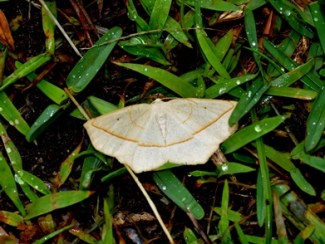
CONFUSED EUSDARCA - 24 May 2016The moth seen in this photo was found by my wife Donna in the grass at our Monroe County home one afternoon shortly after a spring shower.

It is known as the confused eusarca.  it is one of the many small moths that fly about Georgia backyards from April to October.

Measuring a little more than an inch from wingtip to wingtip, at first glance it may appear nondescript.  However, if you closely examine this moth you will find that the dorsal side of its tiny almost white to yellowish tan wings appear to be sprinkled with extremely small bits of grayish brown dust. Larger black dots (discal spots) are also present on the wings  A thin, straight brownish line (that entomologists call the pm line) runs across the wings.  This line makes a turn or seems to disappear near the tips of the wings.

Confused eusarca caterpillars eat a number of plants that commonly grow in Georgia yards such as clover, goldenrod, asters and dandelions.

If you want to better see the wing pattern displayed on the wings of this small moth, look at it through a pair of close focus binoculars or photograph it with your digital camera or cell phone. When you increase the magnification of the picture, the delicate wing pattern will seemingly magically appear.